

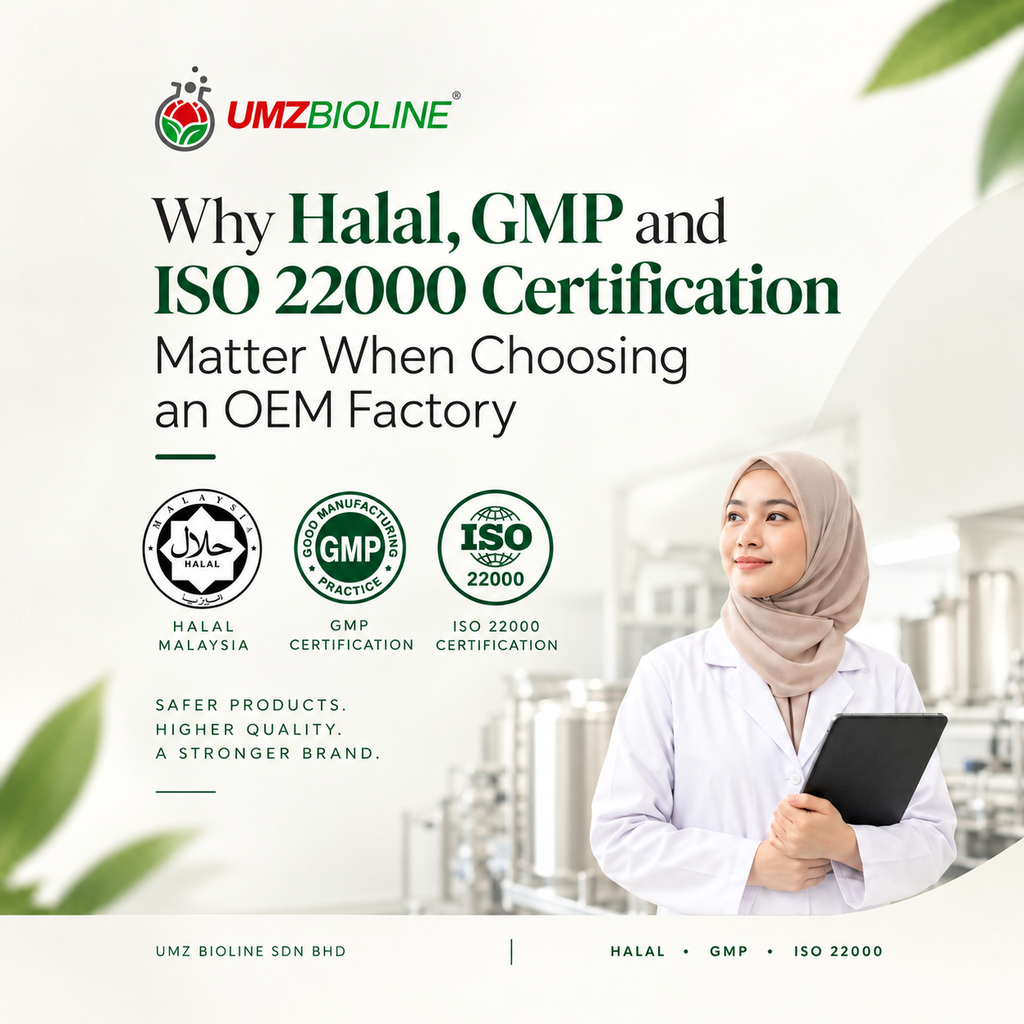
Picking the wrong manufacturer is one of the most expensive mistakes a new brand can make. Before you compare prices or packaging, check one thing first: is it a halal OEM factory with valid Halal, GMP and ISO 22000 certification? These three certificates decide whether your product can be sold legally, trusted by buyers and accepted in export markets.
In this guide, we break down what each certification means, why it protects your brand, and how to verify a factory before you sign anything.
- What Makes a Halal OEM Factory Different?
- Why GMP Certification Is Non-Negotiable
- ISO 22000: The Safety Standard Behind Food, Drinks and Supplements
- Halal OEM Factory vs Uncertified Supplier: The Real Risk
- How to Verify a Factory’s Certificates
- Why Brands Choose UMZ Bioline as Their Halal OEM Factory
- Start With the Right Factory
What Makes a Halal OEM Factory Different?
A certified halal OEM factory does more than avoid pork or alcohol. Halal certification covers the entire production chain, including raw material sourcing, processing, storage, cleaning, packaging and staff handling.
In Malaysia, halal cosmetics are assessed under MS 2634:2019 (Halal Cosmetics – General Requirements), alongside JAKIM’s halal certification procedures. As a result, every ingredient must come from an approved source, and the production line must be free from contamination.
For brand owners, this matters for three reasons:
- Market access. Muslim consumers in Malaysia, Indonesia, Brunei and the Middle East actively look for the halal logo.
- Retail acceptance. Many distributors and pharmacies will not list products without valid halal status.
- Brand trust. A recognised halal logo removes doubt instantly.
You can view our current certificates on our Certificate page.
Why GMP Certification Is Non-Negotiable
GMP (Good Manufacturing Practice) is about consistency and safety. It ensures every batch is produced the same way, in a clean facility, with trained staff and documented processes.
For cosmetics sold in Malaysia, the National Pharmaceutical Regulatory Agency (NPRA) publishes a dedicated Guideline for Cosmetic Good Manufacturing Practice under its cosmetic control guidelines. In other words, GMP is not a “nice to have”. It is part of the regulatory framework.
A GMP-certified factory typically controls:
- Premises layout and hygiene zones
- Equipment calibration and cleaning
- Raw material testing and quality control
- Batch records and traceability
- Complaint handling and product recall procedures
Without GMP, you risk inconsistent batches, contamination and, ultimately, product recalls that can destroy a young brand overnight.
ISO 22000: The Safety Standard Behind Food, Drinks and Supplements
If you plan to launch coffee, health drinks, gummies or supplements, ISO 22000 becomes critical. It is an international standard for food safety management systems, published by the International Organization for Standardization (ISO).
ISO 22000 builds on HACCP principles. Therefore, the factory must identify potential hazards at every stage, control them and keep records that prove it. For export-focused brands, this standard is especially valuable because it is recognised across borders.
Explore the range of OEM beverage products we produce under these food safety controls.
Halal OEM Factory vs Uncertified Supplier: The Real Risk
Some suppliers offer lower prices by skipping certification. At first, this looks like a saving. However, the hidden costs appear quickly:
| Risk | Certified Halal OEM Factory | Uncertified Supplier |
|---|---|---|
| Product notification / registration | Supported with proper documents | Often rejected or delayed |
| Halal logo on packaging | Allowed with valid certificate | Not permitted |
| Batch consistency | Controlled under GMP | Unpredictable |
| Export readiness | ISO 22000 & Halal recognised | Limited or none |
| Brand reputation | Protected | Exposed to recalls and complaints |
Put simply, certification is insurance for your brand.
How to Verify a Factory’s Certificates
Never rely on a logo printed on a brochure. Instead, follow these steps:
- Ask for copies of each certificate and check the company name and address match the factory you are visiting.
- Check the expiry date. Halal, GMP and ISO certificates must be renewed periodically.
- Verify halal status online through the official Malaysia Halal Portal (MYeHALAL).
- Confirm the scope. A halal certificate for food does not automatically cover cosmetics, so make sure your product category is included.
- Visit the factory if possible, and observe hygiene, storage and production flow.
Have more questions? Our FAQ page covers the most common concerns from new brand owners.
Why Brands Choose UMZ Bioline as Their Halal OEM Factory
UMZ Bioline Manufacturer Sdn Bhd is a Bumiputera-owned halal OEM factory based in Ulu Tiram, Johor, with over 15 years of manufacturing experience. Our facility holds Halal, GMP, ISO 22000 and HACCP certification, covering:
- Skin care products – serums, creams, cleansers and sunscreens
- Cosmetics – lip series and colour cosmetics
- Coffee, health drinks, gummies, pills and functional powders
Furthermore, we follow a “1 founder, 1 formula” approach for skincare. Every client receives a unique formulation, never a shared generic base, so your product stands apart from competitors.
We also guide clients through halal application, KKM/NPRA notification and packaging compliance. Learn more about our manufacturing process.
For Malaysian founders who prefer content in Bahasa Malaysia, visit our sister sites: UMZ Bioline Manufacturer, Direct Kilang OEM Malaysia and, for Sabah and Sarawak, UMZ Bioline Borneo.
Start With the Right Factory
Your brand is only as strong as the factory behind it. A certified halal OEM factory gives you legal compliance, consistent quality and the trust you need to grow locally and internationally.
Ready to launch your own halal-certified product? WhatsApp us now for a free consultation or reach us through our contact page.
No comment yet, add your voice below!